

BLOG
AI-Assisted Does Not Mean Inauthentic
Say the idea came from you. The experience came from you. You made the final call on every page. AI just helped you organize it all. So who created that product?
That question is sitting heavy on a lot of digital product creators right now, because Etsy has changed its rules on artificial intelligence. If you sell printables, guides, planners, or workbooks, you may be wondering where you stand. And if you started with PLR, or you’re only a step or two ahead of the customer you serve, you may be wondering whether you still belong there at all.
Mama, take a breath. You do. Let’s talk about why, and about the standard that matters more than any label a platform puts on your work.
What Etsy Actually Changed
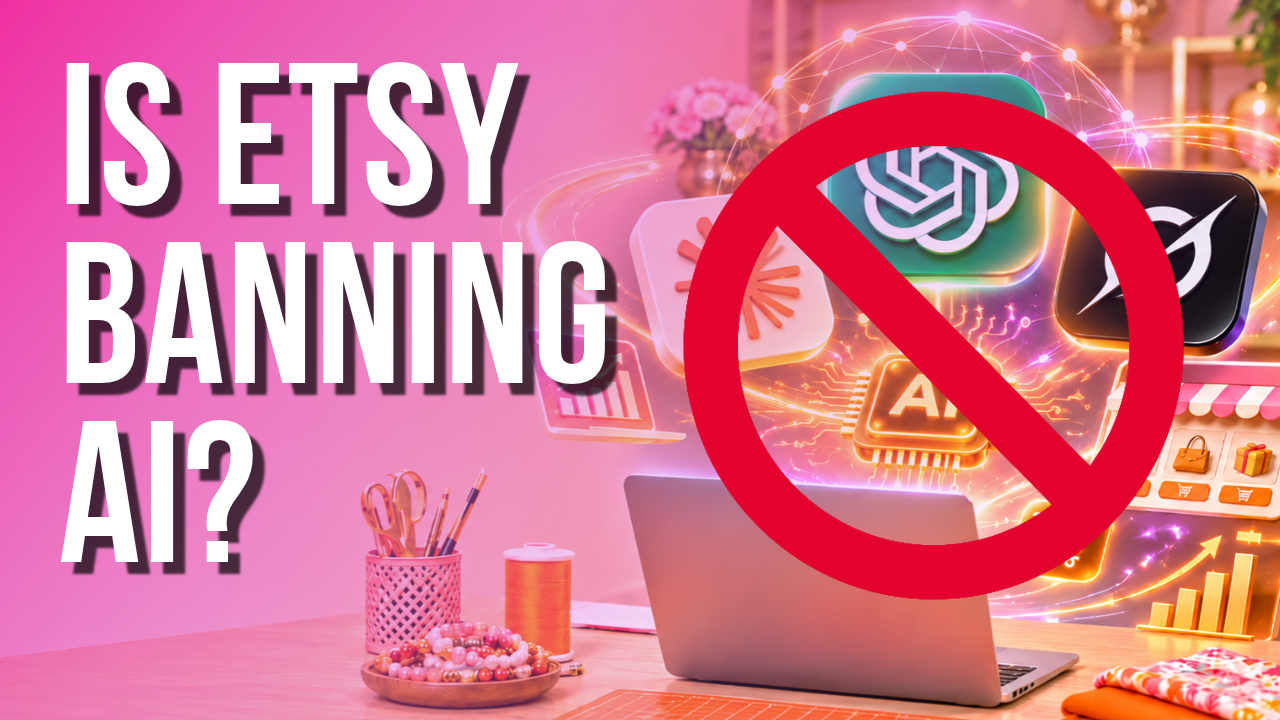
On October 22nd, Etsy announced an update to its AI policy. Like everybody else, Etsy is watching how fast AI is growing and how people are using it. The platform no longer allows AI-generated functional instructions.
Functional instructions are products designed to help a buyer complete a task or get a result. Etsy specifically names patterns, recipes, project plans, manuals, and instructional guides.
Honestly, I understand the concern. Picture a woman sitting down at her sewing machine with a pattern she bought. She invests her time, her money, and her fabric before she finds out the pattern is wrong. If AI invented a step or left out an important detail, she may not discover the problem until it’s too late. That’s the problem Etsy is trying to solve.
The Bot-Generated Listing Problem
Etsy is also cracking down on bot-generated listings. These are products created through mass automation without meaningful human involvement. We have bots, custom GPTs, and programs that can upload listings while we sleep, and Etsy is saying, “Uh-uh. No more.”
This is the part of the update I agree with. We’ve all seen shops fill up overnight with products that seem to exist for one reason only: to take up space in the search results. You search a keyword and get a flood of what is basically the same product with different colors or a different keyword slapped on. That’s what people call AI slop.
Someone types a prompt into ChatGPT or Claude, generates a product, and throws it up on Etsy. They may not know whether the guide is accurate or complete. They may not understand the subject well enough to answer a customer’s question. If you message that seller about the recipe that didn’t turn out, they probably can’t help you unless they go back to AI. And AI may contradict itself, because its answers are rarely the same twice. (Unless you’re asking somebody’s birthday, and even that changes if they’re a celebrity who decided to be younger this year.)
Some of these sellers never even open the final PDF. That kind of volume makes it harder for the real creators out there, the women hand-making designs and handcrafting jewelry, and it lowers buyer confidence across the whole marketplace.
AI-Assisted and AI-Generated Mean Different Things
Here’s the fear I keep hearing: if AI touched my product at all, it’s automatically low quality and banned.
That’s not what Etsy said. Etsy still allows certain seller-prompted AI creations when the seller provides meaningful creative direction and discloses the use of AI. And it has to, because AI is already inside the tools we use every day.
Grammarly is AI. It identifies word patterns and spelling and suggests changes. Canva has AI built right in. A spell-checker may include AI features you never deliberately turned on. So an AI marker can show up on your work even when you supplied the idea, the content, and the creative direction.
That marker can’t tell the whole story. It can’t tell whether you spent three weeks refining your content or three minutes accepting whatever showed up on the screen. It can’t measure how much of your experience is in the final product, and it certainly can’t tell whether the product is useful.
Who Is Doing the Work?
AI assistance starts with a human-led product. You bring the idea, the knowledge, and the intended result: this is what I want the final output to look like, do, or say. AI supports part of the process, and you stay responsible for the finished work. That’s the you factor. That’s the human factor.
Mass-generated content flips that relationship. The software produces the substance, and the seller’s contribution may be limited to picking one of five suggested titles, changing the colors, and uploading the file.
So the real dividing line is whether a human made a meaningful contribution and can stand behind the final product. If you don’t know what’s in your product, you can’t stand behind it. That’s the heart of this whole conversation.
You Don’t Have to Be the Expert
Let’s talk about that word, expert, because it builds a barrier that stops a lot of us from ever moving forward.
If we tell women they can only teach subjects where they are recognized experts, many capable women will never create anything. We’re Jacks of all trades. We know a little about everything, enough to be dangerous. Ask us how the fork was invented and we’ll go find out and give you a piece of an answer. But am I an expert on forks? No. So I can’t write about forks? False.
Instead, we wait for one more certification. Then a second one. We wait another whole year to get the experience we think gives us permission. Meanwhile, we already know something that could help the woman a few steps behind us.
One Step Ahead Is Enough When You’ve Taken the Step
Maybe you just created your first lead magnet and learned what made the process easier. One lead magnet doesn’t make you a subject matter expert. But you learned something that can help someone else. You may not be a nationally recognized funnel strategist, and you can absolutely create a beginner’s checklist based on the process you used to get your lead magnet created and published.
The key is how you position it. You’re sharing a practical starting point from your own experience. You are not claiming your checklist is the only correct way to build a complete marketing funnel. That distinction lets you teach honestly without shrinking what you know.
Being one step ahead works when you’ve actually taken the step. You understand what you did, you’ve reflected on what worked and what didn’t, and you can explain it clearly to the person coming up behind you.
Research Counts Too
The same idea applies to well-researched content. You might create a resource that pulls reliable information into one useful place. Your value comes from the research, the organization, and the interpretation you bring.
Cite your sources. Don’t position yourself as having credentials you don’t have. But you do not need to personally invent every fact before you can create something helpful. Get that out of your mind.
Digital products have always been built from a mix of original ideas, experience, licensed material, research, and creative interpretation. AI didn’t create that reality. It just made production faster.
And speed is where we get ourselves in trouble. When a guide can be generated in minutes, we skip the thoughtful part. We don’t ask whether the information fits our audience. We don’t check whether the steps make sense, whether something got left out, or whether AI embellished or hallucinated something. We go straight from prompt to product without adding the experience, context, or judgment that makes it ours.
Where PLR Fits In
PLR stands for private label rights. (Yes, mom brain had me reaching for that one for a minute.) PLR products are created by another person and sold with a license that explains how you can use, edit, brand, or resell the material.
Human-created PLR can be a legitimate starting point for your digital product. In fact, the Digimompreneur Academy has PLR we’ve created for our members to use as a starting point for their own blogs, social media graphics, shop materials, and even Facebook profile pics. We use PLR and we create it.
When I use human-written PLR, I’m not claiming I sat in front of a blank screen and wrote every word. I bought the right to use that material under the terms of the license. It gives me something to start with, and then I put my own experience into it.
What You Do After the Purchase Is What Matters
If you just change the cover and put your name on it, your customer may be getting the same generic information dozens of other sellers are offering. When you carefully update the content, add your perspective, and adapt it to the people you actually serve, the resource becomes more useful.
That’s the you factor again. Your job is to transform it into something aligned with your brand and relevant to your buyer. You don’t have to hide where it started.
Check the License and the Platform
PLR terms vary. Some licenses let you edit and sell the product. Some only let you edit and use it. Some say you can’t sell it on certain platforms. Plenty of people have tried to get PLR through on Amazon, and Amazon said, “Nah, we don’t do that.” Buying the file does not give you unlimited permission to do anything you want with it.
Selling platforms have their own rules too. Etsy requires digital products to be made or designed by the seller. Its creativity standards specifically exclude PDFs and bundles of someone else’s work. Yes, some of that has slipped through, but that’s no reason to bank on it.
Before you list anything built from PLR, ask yourself two questions:
Do I have permission from the original creator to use this material in this way?
Does the platform allow me to sell what I’ve created from it?
Etsy does not give a percentage telling you how much has to change before something counts as the seller’s original design. Changing two small things probably isn’t going to cut it. Be cautious about calling revised PLR automatically Etsy compliant. If you’re not willing to build on it and inject your own skill, experience, and knowledge of your audience, that may be your sign to skip that particular PLR.
The Real Standard: Meaningful Human Contribution
If expertise isn’t the only standard, what is? I believe it’s meaningful human contribution. The you factor.
That contribution can come from your experience. It can come from responsible research. It can begin with properly licensed, human-created material that you substantially update. The source can vary, but your role should be visible in the finished product.
What It Looks Like in Real Life
Let’s say I buy a human-created PLR workbook on planning social media content. I read it and realize it assumes the customer has several hours every week to create posts. That doesn’t fit my audience. I serve busy moms building businesses around work, children, and family responsibilities.
So I rebuild it around short pockets of time, drawing on my own experience. I remove the strategies that don’t fit moms in this season. I add my own planning method and the productivity tools I actually use. I replace the examples with situations my audience will recognize.
The PLR gave me the starting structure and the order of the content. My understanding of my customer changed the product. That’s meaningful human contribution.
What It Doesn’t Look Like
Now imagine asking AI to create a guide on paid advertising when you’ve never run an ad. You’ve never studied the platform or verified the instructions. You accept the first response, drop it into a template, and have AI write a sales page promising buyers more sales.
The problem here goes beyond not being an advertising expert. Remember, one step ahead is fine. The problem is that you have no reasonable basis for the instructions you’re promising. You can’t tell whether the guide is accurate because you don’t understand the subject well enough to evaluate it.
A responsible creator doesn’t have to know everything. She needs to know enough to recognize what she doesn’t know. She verifies the important information and narrows her promise to what the product can reasonably deliver.
And when a subject requires professional credentials, she respects that boundary. She’s not a doctor, so she’s not giving medical advice. She’s not a lawyer, so she’s not giving legal advice. And she’s not letting AI create documents that promise things she isn’t equipped to stand behind.
Building a Business People Can Trust
You might be thinking, “Fine, I just won’t sell on Etsy.” You can go somewhere else. But this standard is bigger than one platform. It’s about making smart business decisions, gaining more control over your brand, and not leaning on AI to do the creating for you.
If you want to be trusted, and you want to build a business people respect, love, follow, and buy from, then hold yourself to a standard of honesty. We’re not here to push products on people just to close a sale. We’re here to help people. We’re here to make an impact.
AI-assisted does not mean inauthentic. The presence of AI doesn’t automatically make a product careless or fake. At the same time, having access to AI doesn’t give us permission to publish information we haven’t reviewed and can’t support.
Etsy is responding to a real problem: stores flooded with automated products with very little human involvement. The answer isn’t to put every AI-assisted creator under suspicion. The answer is to make our human contribution easier to see.
So, Mama, you don’t need to wait until you know everything before you help someone. Teach what you’ve learned. Create from your experience. Use properly licensed, human-created resources as a starting point when the license and the platform allow it, and let AI support you along the way.
Bring your experience. Add your point of view. Verify your information. Be honest about what your product is designed to do. Then choose a selling platform whose rules fit what you’ve created. That’s a standard newer creators can meet without pretending to be experts, and one experienced creators can keep without giving up the tools that save them time.